Lithuania’s Partisan Marches: A Shield Against Modern Disinformation
In the dense forests of Lithuania, the echoes of a decade-long guerrilla war against Soviet occupation still resonate. For many, these woods are not just a landscape but a living archive of the ‘Forest Brothers’—the partisans who resisted the Soviet regime from 1944 to 1953. As Lithuania prepares for the annual Partisan Honor, Army, and Society Unity Day on May 16th, the focus has shifted from mere historical commemoration to a vital exercise in psychological resilience and national security.
Historical memory serves a role for society similar to that of personal memory for an individual: it defines identity. According to Professor Danutė Gailienė, a prominent psychologist, a society’s ability to remain resilient against modern threats depends heavily on its relationship with its past. In an era defined by hybrid warfare and the weaponization of history, understanding the nuances of national struggle is no longer an academic exercise—it is a defensive necessity.
The Frontline of Historical Memory
History has become a primary target in the field of information warfare. Karolis Zikaras, a representative of the Strategic Communications Department of the Lithuanian Armed Forces, notes that hostile states systematically attempt to rewrite or distort historical narratives. The goal is to erode public confidence, suggesting that the state is a failed project and that resistance is futile.
For decades, Soviet propaganda depicted Lithuanian partisans as ‘bandits’ or ‘Nazi collaborators’ to justify the occupation. Today, similar narratives are repurposed to weaken the moral fabric of the Baltic states. Zikaras argues that the response to such propaganda cannot be more propaganda. Instead, the focus must remain on the truth, however complex it may be. A mature society must be capable of acknowledging both the heroism of its defenders and the difficult moral choices or mistakes made during times of conflict.

Healing Through Shared Trauma
Professor Gailienė points to a psychological paradox: historical trauma can become a source of strength rather than just a mark of weakness. Research into families affected by Soviet repressions and deportations shows that these households often pass down the strongest values—a deep understanding of freedom, the importance of education, and a robust moral compass.
Psychological strength is notably higher in individuals who grew up knowing their family’s history, even if that history included suffering. Conversely, those who grew up in environments of silence or state-mandated lies often feel more vulnerable. This ‘open relationship with the past’ allows for societal healing. It moves the conversation away from binary ‘black-and-white’ thinking toward a nuanced understanding of national identity that can withstand external manipulation.
A Global Call to Action on May 16th
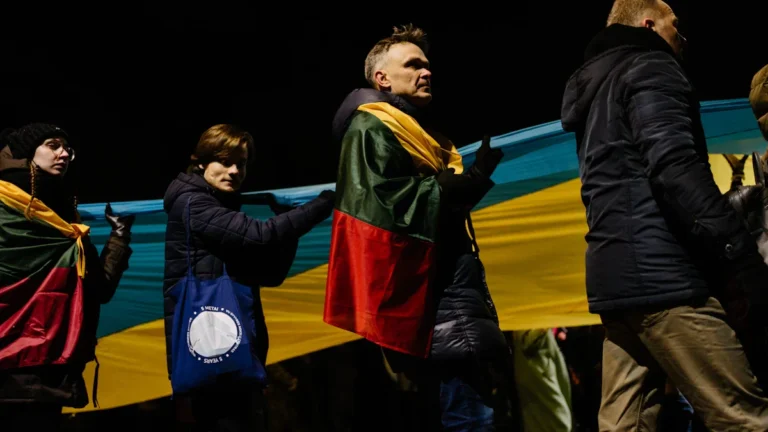
The upcoming commemorations are designed to be more than passive ceremonies. The Ministry of National Defence and the Lithuanian Riflemen’s Union are organizing 10 mass marches across Lithuania, with an additional nine marches taking place within Lithuanian communities abroad, including the UK. These events allow participants to physically step into the reality of the resistance fighters, fostering a sense of continuity between past and present.

The significance of the partisan struggle was vividly demonstrated in 1991, during Lithuania’s push for independence. Many who came to defend the Parliament in Vilnius brought weapons that had been hidden since the post-war years. This was not just a transfer of hardware, but a transfer of the historical will to resist.
From Political Debate to Cultural Identity
The narrative of the partisans has successfully transitioned from the dry halls of political debate into the broader cultural consciousness. Through films, books, and art, younger generations are engaging with the partisan story as a moral and political victory rather than a military defeat. Even though the physical war was lost, the refusal to surrender for ten years against a massive totalitarian machine provided the moral foundation for the eventual restoration of independence. By participating in these marches, the public continues to build an identity that is not only aware of its history but is actively strengthened by it.
Source: BNS


Comments