Lithuania: 76% Back Referendum on Constitutional Family Definition

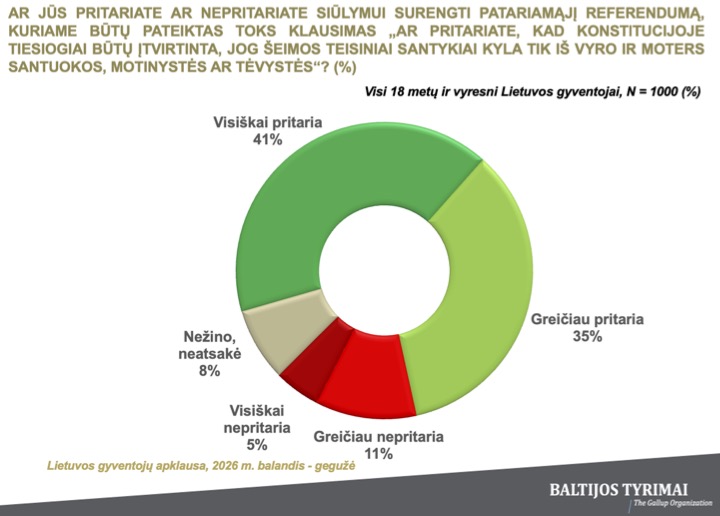
A significant majority of the Lithuanian public supports a move to hold a consultative referendum on the constitutional definition of family, according to new data from Baltijos tyrimai. The survey, conducted between late April and early May 2026, reveals that 76% of citizens believe the public should be directly consulted on whether the constitution should explicitly state that family legal relations arise only from marriage between a man and a woman, as well as from motherhood and fatherhood.
This data arrives at a critical juncture for the Baltic nation, as the Seimas (Parliament) continues to debate the legal framework of family life and the potential for civil unions. The findings suggest that the desire for a referendum is not a fringe movement but a broad-based consensus that cuts across traditional political and demographic divides.
A Cross-Section of Public Consensus
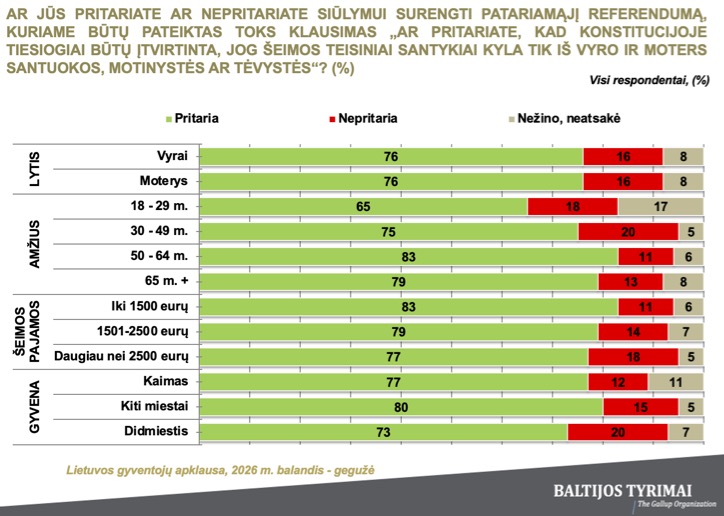
The survey results indicate that support for the referendum is remarkably stable across various social strata. While the highest levels of support were found in smaller towns and rural areas, nearly three-quarters of residents in major cities also backed the initiative.
Perhaps most surprising to observers of Baltic social trends is the level of support among younger demographics and different marital statuses. Even among those under 29—a group typically associated with more liberal social views—65% expressed support for holding the referendum. Furthermore, the initiative saw its highest support among divorced individuals (86%), suggesting that the desire for a clear constitutional definition is shared even by those whose own family structures have changed.
| Demographic / Political Group | Level of Support for Referendum |
|---|---|
| General Population | 76% |
| Divorced Individuals | 86% |
| Married Couples | 78% |
| Youth (Under 29) | 65% |
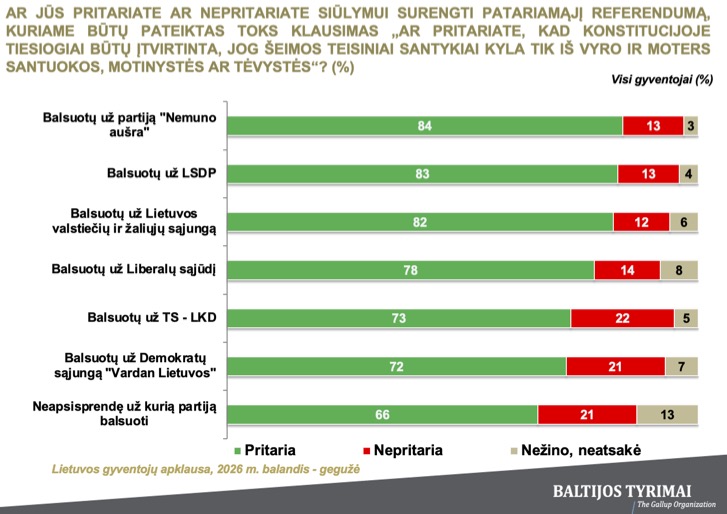
| Social Democrat (LSDP) Supporters | 83% |
| Conservative (TS-LKD) Supporters | 73% |
| Liberal Movement Supporters | 78% |
| Unaffiliated/Undecided Voters | 66% |
Understanding the Data: Support vs. Outcome
It is vital to distinguish between support for a referendum and the eventual vote on the constitutional amendment itself. While 76% support the act of holding a consultative referendum, the survey specifically measured the public’s desire to have a say in the matter. However, the high percentage of those who “completely agree” (41%) with the initiative suggests a strong core of support for the traditional definition being proposed.
The data does not prove that a constitutional change is inevitable, but it does suggest that any attempt to redefine family through parliamentary legislation without a public vote may face significant legitimacy challenges. The margin of error for the study is 3.1%, with a 95% confidence interval, lending high statistical weight to these findings.
Political Implications for the Seimas
The survey highlights a rare moment of alignment among voters of competing political parties. In a polarized political landscape, the fact that over 70% of supporters from both the ruling conservative TS-LKD and the opposition Social Democrats agree on the need for a referendum puts significant pressure on lawmakers.
Historically, Lithuania has seen intense debate over the “Law on the Strengthening of the Family” and various partnership bills. This latest data suggests that the public views the constitutional definition as a foundational issue that transcends party politics. For international observers and UK readers, this reflects a broader European trend where national constitutions are becoming the primary battlegrounds for defining social values in the face of evolving international legal norms.
As the Seimas moves forward with its legislative agenda, this 76% figure will likely serve as a primary talking point for those advocating for a direct public mandate. Whether the government will move to formalize this consultative process remains the central question for the 2026 political calendar.
Source: ELTA
Source check Data Source Transparency
This report is based on a representative survey of 1,000 Lithuanian residents conducted by the market research firm Baltijos tyrimai.
- Verified survey methodology: 1,000 respondents, personal interviews, 3.1% margin of error.
- Cross-referenced political party support levels with current Lithuanian parliamentary alig...
- Contextualized 'consultative referendum' status within Lithuanian constitutional law.
- Source
- elta
- Scope
- Lithuania
- Updated
- 2026-05-19 14:52
Source check
Report a trust issue
Send a clear signal to community moderation if the source, facts or context need review.




Comments